Going along the lines of parallax which I really enjoyed doing I thought I could try out doing the moving images for my final idea. The route I have an idea about is mythology Greek gods, my plan will be to do images of my kids and partner and one group shot of them. I would like to put them in the clouds, gods floating in the sky.
Or I could try multiple exposures/manipulation with them techniques you can do what ever you desire you imagination is free to run wild. If I would choose to go along with this idea I will base it around portraiture to fit in with my own practice.
Images I will need to take for parallax:
Portraits/full body shots
Cloud images
Props needed:
Leaf head garments
White sheets
Grapes
Glass (pretend wine)
Producing a few parallax will be hard work but its a great technique and I'm looking forward to trying it out with my own images.
Images I will need to take for multiple exposures/manipulation:
Portraits
textures
trees/flowers
water
I've drawn a little story board on what I could do for my multiple exposures.
The images would be titles Lost that being a boy has lost his dad by death so I could try and narrate that through the images.
Images taken for my parallax I used a white back drop with a 3 light set up one light using a white umbrella and one using a soft box the third light was directed at the back ground.
For the shoot I used a white table cloth as the toga I made my own leaf head garment and used grapes and dilute ribeana as 'wine'. I wasn't too bothered about the background being creased and messy as my intention is to cut the kids out of that scene to put them in the clouds. On reflection of these images I have over exposed on many of them you can tell this by the whites being blown on the pictures.
This images above I did a levels and curves adjustment in photoshop and applied a blending mode (overlay)to bring the colours out more and it sort of makes you think the whites are supposed to be vibrant and bright you can see the difference from the top image to the original below.
I put together a parallax of lavelle in the clouds. I used an image from the above shoot and cut him out using the pen tool and placed him in the cloud image. Using photoshop I created my layers and opened them up in after effects. With this particular one I found it increasingly hard compared to the snowboarder parallax I completed. I just didn't feel I could create a series of these to a high enough standard I would be happy with to hand in for my final pieces. Although I found it hard I do enjoy trying to create these I will be defiantly carrying on with these as I could always offer these with my photography packages there something different to just the everyday day standard photo you have in the home, with digital frames now I'm sure families couples etc. would love to have these moving on there mantel place. All I can do is keep practising to perfect the technique.
Parallax scrolling is a technique in computer graphics and web design where background images move by the camera slower than foreground images, creating an illusion of depth in a 2D scene and adding to the immersion. The technique grew out of the multiplane camera technique used in traditional since the 1930s. Parallax scrolling was popularized in 2D computer graphics and video games by the arcade games moon patrol and jungle hunt both released in 1982. Some parallax scrolling had earlier been used by the 1981 arcade game jump bug. https://en.wikipedia.org/wiki/Parallax_scrolling 10.02.2016 Parallax is really cool to see a photograph have the dimensions to move I was really fascinated with this technique but looks really complicated to make. Below are some examples I found showing this technique.
https://www.youtube.com/watch?v=VQfgtUw4Vtc
10.02.2016
The wildlife images looks like a slow motion video they really look convincing you wouldn't think the photograph has been animated.
Here's a video I found on Youtube on how the parallax works!
To create your own parallax you need an image which has 3 layers to it. background, mid ground and foreground. They work best if you have a shallow depth of field. First you will need photoshop to cut the different parts of the image out using the pen tool ie, the background and so on. I tried this out myself with an image my tutor provided for me.
After I opened up the image in photoshop I selected the pen tool and cut the snowboarder and snow ledge he's standing on. I then copied and paste on to its own layer and renamed FOREGROUND. Second I cut the mountain range using the pen tool and again copied and pasted on to its own layer. Using the clone tool I cloned some of the clouds from the original layer on to the mid ground layer. I renamed this layer MIDGROUND. The clouds will be your BACKGROUND. Last but not least I used the clone tool again to erase the snowboarder out of the layer so you wont see two of him once I animate the photograph. Once I was happy with my layers I save the document as a PSD and opened up Adobe After Effects. Once In after effects select import - file and select the PSD file select composition. After this loads up drag the files down into the box below in the bottom left corner. Select the box icon this will create a z axis to create the 3D layered image. Add a camera to the layers select LAYER - NEW - CAMERA leave the preset focal length of 50 mm and then select ok. Select custom view and move the layers using the z axis (blue) to position where you want the different layers. Change to active camera and resize all the layers to fit in the frame. Now time to animate the camera using the track z camera tool. You can check how it looks by changing the camera view. When I was happy with the way it looked and moved I could then render the image to play in quick time. Creating the parallax was quite easy to do once you get how to use after effects adding in an camera and moving that around was the hardest part but with my tutor on hand I slowly got to grips with it. Now I was ready to make another.
Videography refers to the process of capturing moving images on electronic media (e.g., videotape, direct to disk recording or solid state storage) and even streaming media. The term includes methods of video production and post production. It was initially equivalent of cinematography (moving images recorded on film stock). The advent of digital video recording in the late 20th century blurred the distinction between videography and cinematography, as in both methods the intermittent mechanism became the same. Nowadays, any video work outside commercial motion picture production could be called videography.
Photographers and film makers are opting to use DSLR's instead of camcorders on more and more occasions, DSLR's are lighter and sometimes cheaper than buying a camcorder but still offering a range of features to produce a film. Being a photographer it would be ideal to get to grips with the features to offer this as one of your packages for your business. Being able to offer video within a package for a christening, wedding or party would increase your chances to compete with other photographers in the market. The software used by amateurs and professionals is normally Adobe Premier to edit and put the film together.
Nick Knight is among the world’s most influential and visionary photographers, and founder and director of award-winning fashion website SHOWstudio.com. As a fashion photographer, he has consistently challenged conventional notions of beauty and is fêted for his groundbreaking creative collaborations with leading designers including Yohji Yamamoto, John Galliano, Alexander McQueen. Advertising campaigns for the most prestigious clients such as Christian Dior, Lancôme, Swarovski, Tom Ford, Calvin Klein or Yves Saint Laurent as well as award-winning editorial for W, British Vogue, Paris Vogue, Dazed & Confused, Another, Another Man and i-D magazines have consistently kept Knight at the vanguard of progressive image-making for the past three decades. He has directed award winning musicvideos for Bjork, Lady Gaga and Kanye West. His first book of photographs, Skinheads, was published in 1982, winning a DandAD award in 1996. He has since produced Nicknight, a twelve year retrospective, and Flora, a series of flower pictures, both published by Schirmer Mosel. His latest book entitled Nick Knight was published by Harper Collins in 2009 .His work has been exhibited at such international art institutions as the Tate Modern, Victoria & Albert Museum, Saatchi Gallery, the Photographers' Gallery, Hayward Gallery and the Gagosian Gallery. In 1993, he also produced a permanent installation, Plant Power, for the Natural History Museum in London.
A long-standing commitment to experimenting with the latest technologies led to Knight launching his fashion website SHOWstudio in 2000, with an aim, in Knight's own words, of 'showing the entire creative process from conception to completion.' SHOWstudio has pioneered fashion film and is now recognised as the leading force behind this new medium, offering a unique platform to nurture and encourage fashion to engage with moving image in the digital age. Since its inception, SHOWstudio has worked with the world’s most sought-after filmmakers, writers and influential cultural figures to create visionary online content, exploring every facet of fashion through moving image, illustration, photography and the written word.
Knight lives with his wife and three children in London. He was awarded the OBE in 2010 for his services to the arts. He is an honorary professor of the University of the Arts London and was awarded an honorary PHD by the same university.
http://nickknight.com/about/ 14.01.2016
Seamus Murphy
Photographer Seamus Murphy (born 1959) grew up in Ireland and lives in London. For over two decades, he has photographed extensively in Europe, the Middle East, Asia, Africa and Latin America. He has won seven World Press Photo Awards. His photography from Afghanistan, which he began in 1994, chronicles the tumultuous life of the Afghan people and won him the World Understanding Award (POYi) This work has been published as a book, A Darkness Visible: Afghanistan (Saqi Books, 2008) and has been exhibited internationally.
Seeing this book and exhibition prompted musician P.J. Harvey to approach Murphy to make a series of films to accompany her album, Let England Shake.
Above all, his subject is the human being. The late photographer Philip Jones Griffiths, author of Vietnam Inc. described Murphy as “a poet with a camera”.
“Photography” says Murphy, “is part history, part magic”.
He aims to explore further the shared language of photography and filmmaking.
Nick Knight works mostly as a fashion photographer working mainly in the studio, he uses light in an extraordinary way and to his advantage while also using mixed media . He also does short films which are aimed more for advertising, his concepts are outlandish and out there but this imagination brings out really interesting great images/short films.
https://www.youtube.com/watch?v=JiSQHJ_a5Z0
Not content with the traditional fashion show set up and intrigued by the possibilities offered by the web for displaying fashion, the ever forward-thinking Tom Ford tapped Nick Knight to direct a fashion film featuring his S/S 16 collection. Released in conjunction with Paris Fashion Week, the video features Lady Gaga alongside models Mica Arganaraz, Lexi Bolling, Kayla Scott, Xiao Wen Ju, Valery Kaufman, Aymeline Valade, Lida Fox, Lucky Blue Smith, Alex Dunstan, David Agbodji and Tarun Nijjer.
Ford says, ‘Instead of having a traditional show this season, I decided to try something new. Having a runway show has become so much about the creation of imagery for online and social media and watching a filmed fashion show can be like watching a filmed play [which is never very satisfying]. I wanted to think about how to present a collection in a cinematic way that was designed from its inception to be presented online. I have always loved Soul Train which used to be on TV in the seventies; as it was as much about the clothes as the music. I asked Nile Rodgers to collaborate on a new version of one of his great hits from that time, I Want Your Love, and worked with Gaga to record the vocals. Gaga and Nile are both brilliant artists and the resulting collaboration between the two of them is, I think, very powerful. I then staged a full show in Los Angeles and filmed it with Gaga on the runway, Nick Knight directing and Benoit Delhomme as our director of photography. We pulled frames from the video that will be used for our look book, photographed the ad campaigns, and shot the beauty images all at the same time. It was a great deal of fun to do and I think that the video captures the spirit of the collection in a way that a filmed traditional show would not have.’
Seamus Murphy also works as a photographer and creates short films while Knight works with his unusual weird themes, Murphy works along the lines of what's out in the world. Showing the viewers what's really happening. He spent time in Afghanistan documenting the conflict and turmoil. The way in which he composes his images gives an emotional feel and pull on the heart strings. He knows how to work the camera to give an insight and story on what he's trying to get over to the viewer. His photography propels his short film making to a high ranking. With his knowledge of framing composition and lighting it makes his film making fantastic.
This particular short film was from his time in Afghanistan, this film is truly a work of art every take of the film you can see the still image. His composition and framing is perfect, he travels you through the video leading your eye into every part. To be able to create something so moving and structurally amazing is a fascinating ability. This is were Nick Knight and Seamus Murphy are the same they both have the ability to wow their audiences both with photography and film, but both are completely different in their own right.
Lunch Time - Emma
My attempt at my first video which was put together in premier that is a hard piece of software to get used to. I didn't really enjoy doing video I much preferred stop frame animation. This video I did was a quick try in the cafeteria. I didn't have a plan on what I was going to shoot or how I was going to frame it. The video doesn't work very well but I tried it and tried out premier to put the video together. I got edit and chop up the video which was useful and beneficial to learn. To produce a well made short film planning is key! Think about the narrative in the story if it will even have one, the composition, lighting the atmosphere im trying to get across through to the viewers.
What is Stop Motion? Stop motion is an animation technique that physically manipulates an object that appears to move on its own. The object is moved in small increments between individually photographed frames, creating the illusion of movement when the series of frames is played as a continuous sequence. Dolls with movable joints or clay figures are often used in stop motion for their ease of repositioning. Stop motion animation using plasticine is called clay animation or "clay-mation". Not all stop motion requires figures or models; many stop motion films can involve using humans, household appliances and other things for comedic effect. Stop motion using objects is sometimes referred to as object animation. https://en.wikipedia.org/wiki/Stop_motion I will be trying out stop frame animation for myself. But before I go into the technique I'll be looking at some stop frame animation videos, and researching how to create a good piece of stop frame. The point of animation is to break the rules, its a playful technique which breaks the rules of reality. There's a video I watched by Norman Mclaren from 1952 which uses stop frame and video combined. The video is called neighbours which came about in the 1950's.
Sound for this particular animation is the most important thing. The animation goes along with the animation the sounds add to the piece and make it have a more atmospheric mood to it.
The animation is both deep and funny together with an underlining message within it. They initially forgot about what they were fighting over (the flower), that became unimportant to them. Their main focus was to keep harming each other, throughout the animation their face gets painted in black face paint this is resemble the evil within coming out. The darkness from in their soul coming to surface the more they inflict pain and misery on one another. The colour from the actual animation drains away becomes more saturated as the story unfolds this also goes with their mood and action, as they become more darker within themselves the colour of the animation is less vibrant and happy.
The irony actually is that the same flower they argue and fight over grows on top of their graves in the end.
Below is another animation I looked at by Jan Svankmajer he done a series of animations called Food, the one I selected is Breakfast!
Food is a 1992 Czech animated short film directed by Jan Švankmajer that uses claymation and pixilation. It examines the human relationship with food by showing breakfast, lunch, and dinner. https://en.wikipedia.org/wiki/Food_(film) 15.12.2015
In this animation Jan challenges the ideas of communism, things we take for granted in a time when things were massively controlled. The people are portrayed as machines they become the state. People feeding people where everyone has the same everything even same meal no exceptions. In the end of the animation you see a long line queuing up for the next one to go in for the same meal, again representing the control over these people.
Combing animation and video together - Peter Gabriel Sledgehammer
https://www.youtube.com/watch?v=OJWJE0x7T4Q
This is another video I looked at it has a wide range of techniques going off in the video, including pixel, clay and video. The piece is truly outstanding in which he has created this piece.
This has excited me to try out facial expression animations with the kids at home, I was thinking of some sour sweets and then photograph them to put into an animation. With the sour sweets I will get some really weird and fast changing expressions which should make some interesting pieces.
First attempt at stop frame animation was a self decorating tree, I worked on this with Shannon. Firstly we had the lights creeping up the branches taking two photographs at each step only moving the lights bit by bit. Once the lights reached the top we then did the same with the tinsel taking the images bit by bit again. After all the images were taken I used After Effects to put the animation together.
By Shannon & Leonie
I attempted another go at stop frame animation giving sour sweets to my son and watching his facial expressions.
Born on May 1, 1968 in Bordeaux, France, Alain Laboile is a photographer and father of six.
In 2004, as he needed to put together a portfolio of his work as a sculptor, he acquired a camera, and thus developed a taste for macro photography, spurred by his passion for entomology.
Later on, he pointed his lens towards his growing family which became his major subject, be it in a realistic depiction of their atypical lifestyle in “La Famille”, or in bizarre stagings around a pond in “Réflexion autour du bassin”.
Alain Laboile's work has since been exhibited around the world and he is scheduled to publish a book with Steidl Verlag.
These images are really exciting to how hes created them, as when you normally take reflections you catch yourself in the images. So to create the images in reflections it gives a sort of dream land image it would be interesting to create images like this. Subject matter in his images is like everyday scenes from a kids/family life.
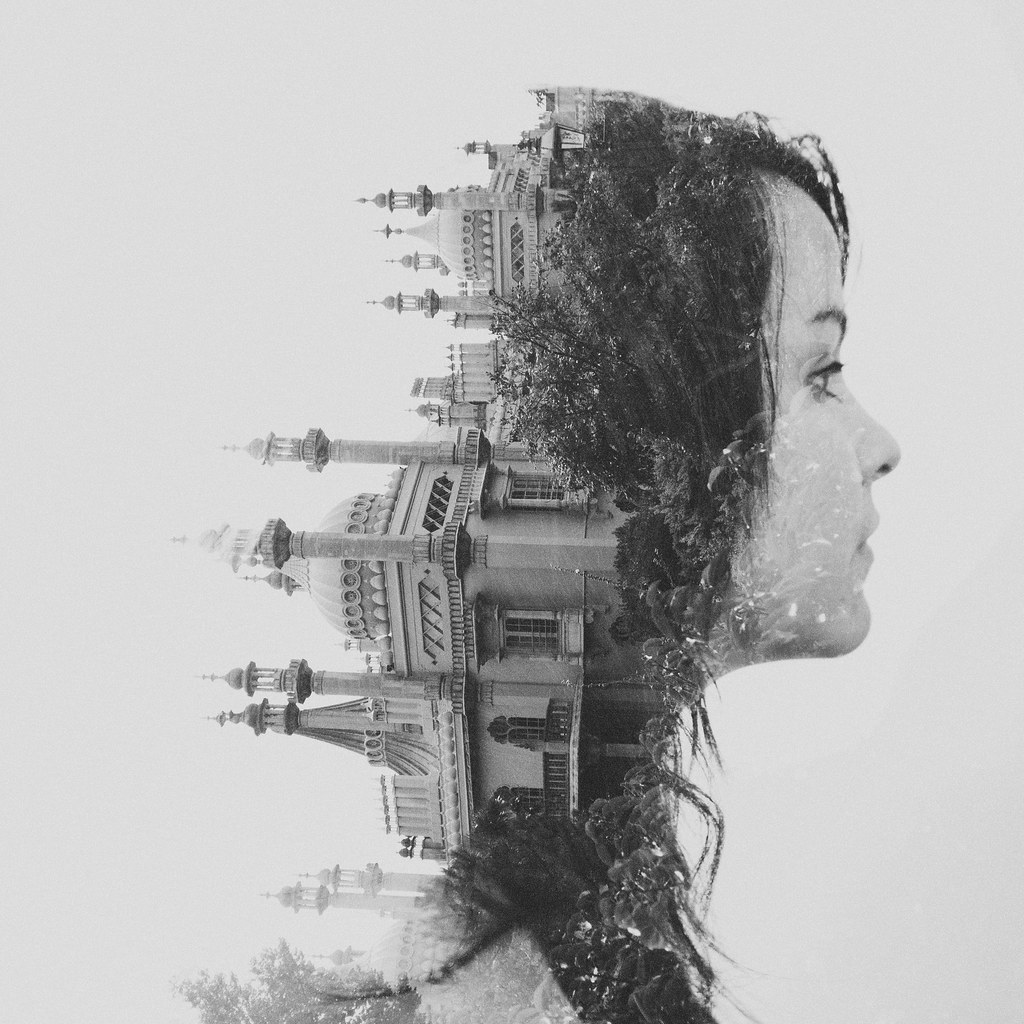
Dan Mountford is a freelance graphic designer and photographer residing in Brighton, England. He is most well known for his stunning double exposure photography, which he describes as “a visual journey through our minds by calm and tidy means which the reality of everyday life does not show”. Mountford captures his dual subjects beautifully, giving life to new composite images that take on unique, surreal forms. Even more impressive, the exposures themselves are created entirely by camera
Dan's double exposure images are really interesting and how he composes these images in camera is really cool, to be able to create these in camera would save time in doing it in photoshop. I like how he brings in the landscapes, city scapes, nature and buildings to look as if they are one with the model. I want to create more multiple exposures some more creative images.
I created this double exposure in photoshop, the images were taken on a 5x4 camera. I chose which images i wanted to use and simply overlayed one over another while changing the opacity on the top image to just bring the flower image through over the models face.
Nancy Lee was born in Hong Kong but has lived around the world, she first started taking these images of around Hong Kong then was encouraged to go and photograph Holland from the same perspective. As Holland is really quite flat she had to use a plane to get the height in the images. The image swimming about was taken in Budapest at a spa, she didn't intentionally go to photograph the spa but the opportunity presented itself as she walked out onto a balcony. She ended up stood there for 45 minutes taking over a 1000 photograph to create 'swimming about'. These images that Nancy Lee has produced are really eye catching and abstract, this technique looks so exciting to try out. Her images mainly explore subjects such as pedestrians, traffic and market life. The one of the open umbrellas she turns into an abstract image of coloured dots all over. There taken really high up to get the view from above birds eye view, then to cut and stitch the images together must of taken her some time to get them to look pleasing together. Its almost a puzzle what you are trying to put together in your mind from the fragmented pieces of the images.